Hot Melt Tips12 May 2008 04:23 pm

“Burn In” sticks are resins used to fill holes in wood material prior to sanding and painting.

These sticks must be melted and applied to the wood in a molten liquid form.

Typically, an open flame is used to melt this resin; hence the name “Burn In” is used.

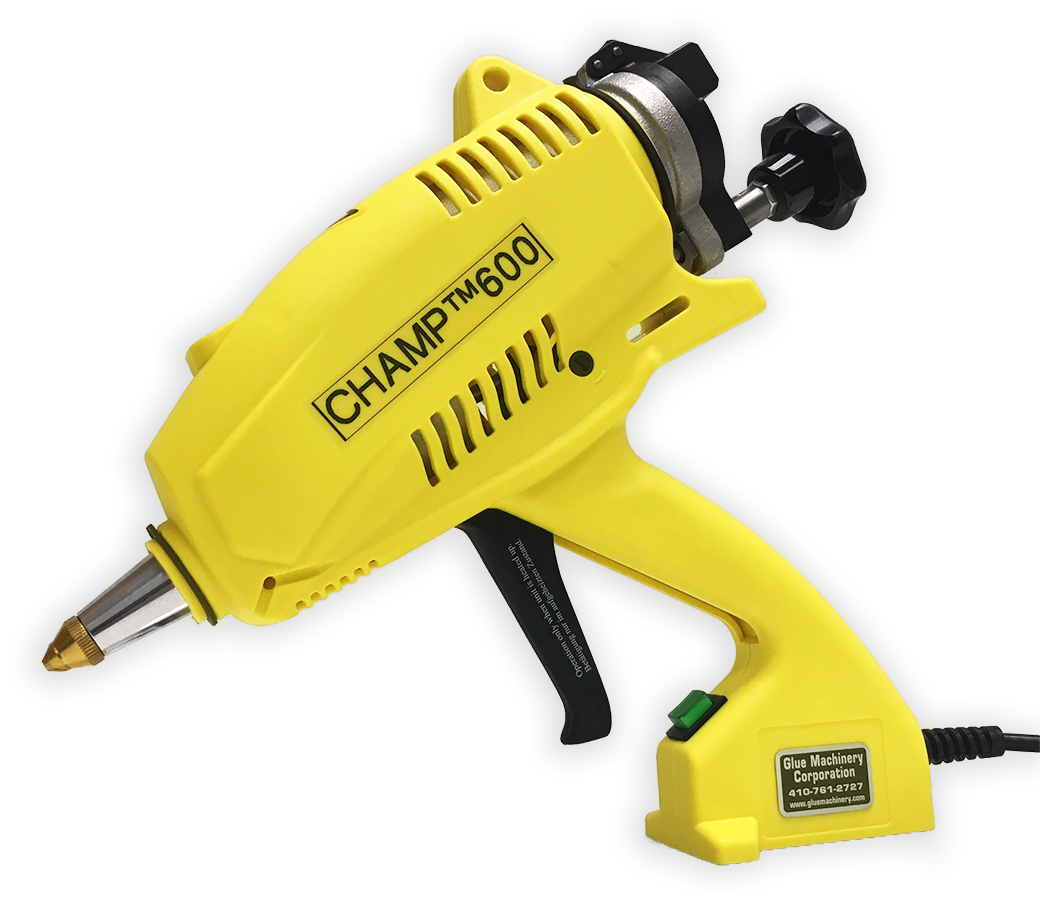
Recently, hot melt handguns such as the Champ 3 and Champ 5 with internal reservoirs have been used to melt and apply Burn In wood filler material.

Using these hot melt handguns improves production speeds, improves the quality of the filler material, and is overall cleaner and safer than the alternatives.

An important tip to consider in this process is to attempt to operate the guns at the lowest possible temperature to eliminate the degradation of this heat sensitive filler material.

Contact Pierce Covert
or visit www.gluemachinery.com
to learn more about this process and how Glue Machinery Corporation can improve your woodworking and adhesive needs.

Hot Melt Tips& Video entries10 Apr 2008 03:01 pm

Many filters are produced in longer lengths than are needed and can can be cut in half to produce two filters or to offer a custom length filter. When cut these filters exposed ends need an “End Cap” attached to finish the product.

The End Cap is folded around the end of the filter and bonded to the filters cardboard frame and filter substrate with adhesive. Many customers apply heat reactivatable or water based adhesive that must be heated and clamped to bond. This requires special clamping equipment and when done manually this process is extremely slow.

For fast manual assembly, Glue Machinery Corporation recommends a long open time hot melt that is applied by an open wheel hot melt roll coater directly to the flat end cap. One operator can easily complete one end cap gluing process every 5-10 seconds with a properly scored end cap. With the correct hot melt adhesive and rollcoater machine to provide exact coat weights, temperature, and coating speeds- your production speed can be maximized and process streamlined.


Hot Melt Tips10 Apr 2008 03:01 pm

Mass Mailing houses use wafer seals or “Tabs” to hold their mailers closed. These clear plastic pressure sensitive backed circles are applied in-line at the end of a buckle folder.Typically, tabbing machines apply these closure devices/tabs at speeds of up to 3,000 pieces per hour. Wafer Seals or “Tabs” cost approximately $1.40 per thousand and are situated on rolls. These rolls must be changed regularly, requiring the stoppage of the buckle folder. Tabbing machinery has to be monitored closely as it has a propensity to jam easily.

An option to Tabbing is Hot Melt Removable “Tacking” . Dots of hot melt are applied prior to the fold plate with no speed limitations, which allows the buckle folder to operate at maximum speeds up to 15,000 PPH. Hot Melt Fugitive adhesives cost approximately 70 cents per thousand dots. Hot Melt systems are filled while in operation allowing the buckle folder to run continuously. Hot Melt Removable “Tacking” systems are easily operated and are relatively care free when operated properly. Hot melt tacking from within the mailer does not affect the visual aesthetics of the piece and hot melt tacking is easier to open than product with tabs. Finally, hot melt tacking has gained acceptance as it is used extensively for credit card applications and “Tipping” applications where additional pages or coupons are inserted into product for easy removal.

To further discuss your options and individual needs for tabbing or tacking your mailers
Contact Pierce Covert or visit Glue Machinery Corporation for more information.

Hot Melt Tips10 Apr 2008 02:56 pm


Hot Melt Tips10 Apr 2008 02:53 pm


Hot Melt Tips09 Apr 2008 11:25 am

PUR Hot Melt is an incredibly valuable adhesive for product assembly applications. This hot melt cures and cross links to a very strong, chemical resistant adhesive with high and low temperature flexibility. It is now used for aerospace, automotive, construction, woodworking, plastics packaging and product assembly applications where fast permanent bonding and assembly are required.

This specialized hot melt is only available in cartridge, slug, pail and drum form and must be processed by PUR cartridge gun, specially designed reservoir, pail or drum unloader.

You can review the PUR 50 in operation by watching the following video:


This system processed 2 kilo slugs of PUR and can operate with handguns and automatic guns. It has a special tank lid and dry air purge system with alarm that insures that the adhesive in the reservoir is not exposed to moisture in the air. Another important feature is its variable speed pump which allows for precise line tracking and coat weights at variable speeds.

Hot Melt Tips& Email Signup - HotMeltNews09 Apr 2008 11:23 am

For those who may not have utilized RSS Feed technology , there is a new and easier way to keep *instantly* updated whenever a new article is published. Powered by RssFwd, (a service of Blue Sky Factory, Inc) this service provides an email notification whenever a new article appears on “Hot Melt News.”

This site neither lists nor sells your email address. Just visit www.rssfwd.com and enter in www.hotmeltnews.com as a subscription site. This is a simple and effective way to keep up to date on all our latest news, deals, and tips from Glue Machinery Corporation.

At the footer of each email you receive from RSSFwd, there will be hassle-free links for you to UNSUBSCRIBE or MANAGE your subscriptions.

Keep in mind, this is not a replacement subscription to your Hot Melt News mailing. RSSFwd is not affiliated with Glue Machinery Corporation- it is merely a tool or option for you to utilize to keep up to date with Glue Machinery Corporation.
We strongly recommend you also subscribe to our mailing list via www.gluemachinery.com to insure you receive all official correspondence directly from Glue Machinery Corporation.

Hot Melt Tips& Video entries04 Apr 2008 05:35 pm

New Video posted to our Youtube channel:


Hot Melt Tips04 Apr 2008 12:11 pm

Hot Melt

  • Known as hot melt or thermoplastic resin
  • Has fast bonding capabilities
  • Typically at temperatures between 275 to 375F
  • Used for packaging, printing, bindery,interior assembly applications among others
  • Available in a variety of forms to include stick, chip, pellet, wafer, block, pail and drum
  • Must be processed in a hot melt unit
  • Offers a strong surface bond to a wide range of substrates
  • Non toxic and non flammable


Animal Glue

  • Protein based adhesive
  • Must be applied at 150F
  • It is a good cross between hot melt and white glue.
  • Offers good open time before making lamination between porous substrates
  • Repulpable and biodegradable
  • Available in gelatinous form that must be processed in specific heated machinery

PUR Hot Melt

  • Known as Moisture Curing Hot Melt
  • Available with short or long open times and fast set times
  • Bonds a wide range of substrates
  • Cures to a strong, flexible bond
  • Available in cartridge, slug , pail and drum form
  • High and low temperature resistance

White Glue

  • Known as polyvinyl acetate (PVA).
  • A non-waterproof adhesive often used for interior woodworking jobs, where a waterproof joint is not required.
  • Usually packaged in plastic squeeze bottles, these inexpensive, milky-white glues dry clear and are fast setting.
  • Bonds paper, fabric, cardboard, cork and leather, as well as wood
  • Can withstand a moderate amount of strain and cleans up easily with soap and water
  • Non toxic and non flammable.
  • Inexpensive milky-white glues are fast sitting and dry clear

Woodworkers’ Glue

  • Also called carpenter’s glue
  • Has a faster grab than white glue (set time is usually within 15 minutes)
  • Is usually tinted an off-white or yellow
  • Woodworkers’ glue is used in applications where better water resistance, heat resistance and ease of sanding are desired
  • Non toxic and non flammable


Instant-Setting Glue

  • Known as Super Glue (cyanoacrylates)
  • This glue creates a strong, instant bond with a small amount of glue
  • Regular cyanoacrylates will bond almost all non-porous materials such as ceramic, some plastics, rubber, metal or synthetics
  • Comes in gel form
  • Should be handled with extreme care and kept off of skin

Epoxy

  • Epoxy is designed primarily for the bonding of non-porous surfaces, but can also be used effectively on wood
  • Available in clear, white or metallic finish
  • Most epoxies come in two parts: a resin and a hardener (or “catalyst”) which must be mixed together before the adhesive is used
  • Once mixed, the material will set permanently in a specified length of time—most will permanently bond, even under water
  • The bond will withstand most solvents when curing is complete
  • Excellent for sealing gaps and will withstand vibration and shock
  • Can be used on pipes, radiators, wood, metal, ceramic tile, china, marble, glass and masonry
  • Since epoxy is toxic and flammable, use extreme caution when handling


Polyurethane Glue

  • Is a one-part adhesive offering the strength of an epoxy without mixing
  • Generally requires 4 to 24 hours to fully cure, but it does bond to most materials
  • Cures in the presence of moisture, so wetting one or both materials to be joined is required
  • Good for a bond between either similar or dissimilar surfaces, is commonly used in woodworking
  • Waterproof, sandable, paintable and stainable

Contact Cement

  • Can be used on many surfaces, but the joints may come apart under a heavy load
  • Good to bond laminates to countertops and cabinets, or to glue plastic foam, hardboard or metal to wood
  • Instant adhesion makes contact cement difficult to use. It bonds immediately without clamping and resists water, temperature extremes and fungi
  • Contact cement is most effective when one or both surfaces are porous or semi-porous
  • Contains solvents that should be allowed to flash off before assembly
  • Non-flammable versions are available

Resorcinol Glue

  • Is two-component adhesive of liquid resin and powdered catalyst
  • Used in wood joints, it cures under pressure in 10 hours at 70° F.
  • Ideal for exterior structural applications because of its waterproof and weatherproof qualities

Silicone Rubber Adhesive

  • Ideal for strong, flexible joints on wood, dissimilar surfaces such as metal, rubber, glass, ceramics, brick, wood and polystyrene foam


Plastic Resin Glue

  • Known as powdered urea formaldehyde glue
  • When mixed with water, it makes highly water-resistant bonds
  • Frequently used for furniture repair, it is applied to clean, close-fitting surfaces and cured under pressure for at least 10 hours at 70° F
  • The finished glue is non-toxic and impervious to most materials


Construction Adhesive

  • Known as mastic, which is also a general term for any thick adhesive
  • Used in heavy-duty bonding and construction applications
  • Mastics are usually applied with a caulking gun or trowel
  • Reduces the need for screws, nails and other fasteners in construction
  • Flexible and waterproof qualities make them ideal for outdoor applications
  • Can be used to join flooring and sub-flooring, paneling, drywall and roofing, molding, tile, masonry and concrete, metal and wood
Hot Melt Tips31 Mar 2008 09:39 am

Use of cushions and seating for outdoor, automotive, and bath should not easily absorb water through seams on or under the seat / cushion.

An easy way to seal the overlapping seams on the bottom side of these products is to apply a flat bead of industrial clear hot melt from a pneumatic hot melt gun.

In this process the adhesive covers and wicks into the seal. The proper gun/nozzle combination will allow for the seaming at a fast and consistent rate.

Simply apply a 1/4″ wide by .030″ thick coating to the overlapping seam on the bottom of your vinyl or other material cushion and the water resistance / non absorption of water is dramatically improved.

Please note that testing is available to prove the value of this equipment and adhesive, but all customers must ultimately determine the short and long term value of these processes and adhesives for their particular needs.


Contact Glue Machinery Corporation or click here for more information on this process or to place an order.

Next Page »